The Greek word agalliasis means joy. But not just plain joy; it means exuberant joy, jubilation. It's the kind where you're sitting in your home stadium and your team does something great, and the entire crowd jumps to its feet and screams "YEAH!" The way everyone in America must have felt on VJ Day in 1945. That kind of joy.
Joy is all over the Bible, but this particular, explosive word for joy only appears twice in the New Testament. The first time concerns Mary (who was pregnant with Jesus) and her relative, Elizabeth (who was pregnant the John the Baptist):
Now at this time Mary arose and went with haste to the hill country, to a city of Judah, and entered the house of Zacharias and greeted Elizabeth. And it came about that when Elizabeth heard Mary's greeting. the baby leaped in her womb; and Elizabeth was filled with the Holy Spirit. And she cried out with a loud voice, and said, "Blessed among women are you, and blessed is the fruit of your womb! And how has it happened to me, that the mother of my Lord should come to me? For behold, when the sound of your greeting reached my ears, the baby leaped in my womb for joy." (Luke 1:39-44)
John the Baptist felt that kind of joy while still in the womb. I guess he was a prophet even at that age!
But "agalliasis" joy becomes more personal for us in the second and only other place it's found in the New Testament. I just love this. The song "I Can Only Imagine" wonders what we'll feel when we're saved and stand clean and forgiven before Him. Will we dance? Be still? Fall on our knees? Sing? We don't have to imagine. Jude's benediction at the end of his book gives us a great picture of what we'll feel:
Now to Him who is able to keep you from stumbling, and to make you stand in the presence of His glory blameless with great joy.... (Jude 24)
Monday, July 7, 2008


Friday, June 20, 2008
"Who is this Son of Man?"
The multitude therefore answered Him, "We have heard out of the Law that the Christ is to remain forever; and how can You say, 'The Son of Man must be lifted up?' Who is this Son of Man?" (John 12:34)
I wanted to call this post "The amazing Son of Man," but it sounded too much like the amazing Spiderman. Oh well. He's still amazing.
When Jesus was on the earth, He called Himself by the name "Son of Man" more than any other name. You can find Him mentioning the name "Son of Man" more than 80 times in the New Testament.
When He does, this is what He's referring to-- something that was written by the prophet Daniel more than 500 years before:
I kept looking in the night visions, and behold, with the clouds of heaven, one like a Son of Man was coming, and He came up to the Ancient of Days and was presented before Him.
And to Him was given dominion, glory and a kingdom, that all the peoples, nations, and men of every language might serve Him.
His dominion is an everlasting dominion which will not pass away; and His kingdom is one which will not be destroyed. (Daniel 7:13-14)
I like to try to picture the clouds, picture Him before the throne, imagine Him receiving that kind of everlasting authority. Then with that picture in mind, to read some of the amazing things He said about Himself when He was here, walking among his disciples:
"The foxes have holes, and the birds of the air have nests; but the Son of Man has nowhere to lay His head." (Matthew 8:20)
"...for just as Jonah was three days and three nights in the belly of the sea monster, so shall the Son of Man be three days and three nights in the heart of the earth." (Matthew 12:40)
"Behold, we are going up to Jerusalem; and the Son of Man will be delivered to the chief priests and scribes, and they will condemn Him to death, and will deliver Him to the Gentiles to mock and scourge and crucify Him, and on the third day He will be raised up." (Matthew 20:18-19)
"For even the Son of Man did not come to be served, but to serve, and to give His life a ransom for many." (Mark 10:45)
"For the Son of Man has come to seek and to save that which was lost." (Luke 19:10)
"And as Moses lifted up the serpent in the wilderness, even so must the Son of Man be lifted up; that whoever believes may in Him have eternal life." (John 3:14-15)
"Truly, truly, I say to you; unless you eat the flesh of the Son of Man and drink His blood, you have no life in yourselves." (John 6:53)
According to Daniel's prophecy, Jesus would be an everlasting King...The Everlasting King. The disciples, Pharisees, chief priests and others must have been familiar with the prophecy, at least to some extent. I wonder what Jesus' words sounded like to them?
I wanted to call this post "The amazing Son of Man," but it sounded too much like the amazing Spiderman. Oh well. He's still amazing.
When Jesus was on the earth, He called Himself by the name "Son of Man" more than any other name. You can find Him mentioning the name "Son of Man" more than 80 times in the New Testament.
When He does, this is what He's referring to-- something that was written by the prophet Daniel more than 500 years before:
I kept looking in the night visions, and behold, with the clouds of heaven, one like a Son of Man was coming, and He came up to the Ancient of Days and was presented before Him.
And to Him was given dominion, glory and a kingdom, that all the peoples, nations, and men of every language might serve Him.
His dominion is an everlasting dominion which will not pass away; and His kingdom is one which will not be destroyed. (Daniel 7:13-14)
I like to try to picture the clouds, picture Him before the throne, imagine Him receiving that kind of everlasting authority. Then with that picture in mind, to read some of the amazing things He said about Himself when He was here, walking among his disciples:
"The foxes have holes, and the birds of the air have nests; but the Son of Man has nowhere to lay His head." (Matthew 8:20)
"...for just as Jonah was three days and three nights in the belly of the sea monster, so shall the Son of Man be three days and three nights in the heart of the earth." (Matthew 12:40)
"Behold, we are going up to Jerusalem; and the Son of Man will be delivered to the chief priests and scribes, and they will condemn Him to death, and will deliver Him to the Gentiles to mock and scourge and crucify Him, and on the third day He will be raised up." (Matthew 20:18-19)
"For even the Son of Man did not come to be served, but to serve, and to give His life a ransom for many." (Mark 10:45)
"For the Son of Man has come to seek and to save that which was lost." (Luke 19:10)
"And as Moses lifted up the serpent in the wilderness, even so must the Son of Man be lifted up; that whoever believes may in Him have eternal life." (John 3:14-15)
"Truly, truly, I say to you; unless you eat the flesh of the Son of Man and drink His blood, you have no life in yourselves." (John 6:53)
According to Daniel's prophecy, Jesus would be an everlasting King...The Everlasting King. The disciples, Pharisees, chief priests and others must have been familiar with the prophecy, at least to some extent. I wonder what Jesus' words sounded like to them?
Thursday, May 29, 2008
The view from Mars Hill
I've tried to reconstruct the lost post (see below). Here it is:
One time when the apostle Paul was traveling, about 55 AD or so, he made a stop in Athens. He spent time with the people in the market place and told them about Jesus, but got a mixed reaction:
And also some of the Epicurean and Stoic philosophers were conversing with him. And some were saying, "What would this idle babbler wish to say?" Others, "He seems to be a proclaimer of strange deities,"--because he was preaching Jesus and the resurrection.
And they took him and brought him to the Areopagus, saying, "May we know what this new teaching is which you are proclaiming?" (Acts 17:18-19)
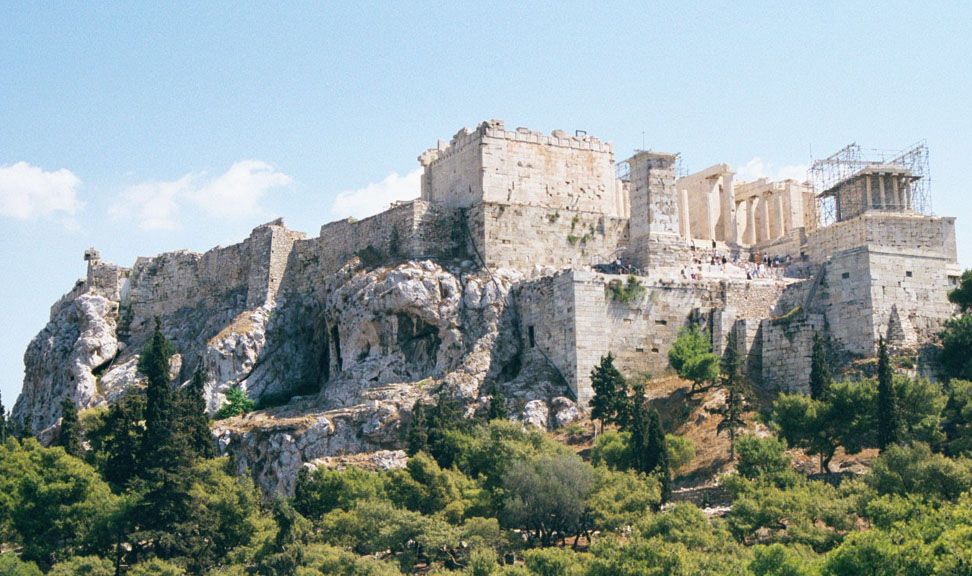
I think it's really interesting that they took him to that particular spot. The Areopagus is a treeless marble hill that sits just across from the great entrance to the Acropolis. Inside the Acropolis were the Parthenon, several temples to Athena, sanctuaries for Zeus and Artemis, a theater honoring Dionysus, a few statues and some other things. Paul and the crowd had a perfect view of both the great entrance and the Temple of Athena Nike, already over 400 years old at the time.
You can see what Paul saw, the view of the Acropolis from the Areopagus, here:
http://www.grisel.net/images/greece/Acropolis22.JPG
The Areopagus (or Mars Hill) was used as a spot for trying social, criminal and philosophical questions before the Athenian council.
Anyway, back to the Bible:
"May we know what this new teaching is which you are proclaiming? For you are bringing some strange things to our ears; we want to know therefore what these things mean."
(Now all the Athenians and the strangers visiting there used to spend their time in nothing other than telling or hearing something new.)
I love that part. They'd make good Americans!
And Paul stood in the midst of the Areopagus and said, "Men of Athens, I observe that you are very religious in all respects. For while I was passing through and examining the objects of your worship, I also found an altar with this inscription, 'TO AN UNKNOWN GOD.' What therefore you worship in ignorance, this I proclaim to you.
Now imagine being in that setting, with that view, and hearing this next part:
"The God who made the world and all things in it, since He is Lord of heaven and earth, does not dwell in temples made with hands; neither is He served by human hands, as though He needed anything, since He Himself gives to all life and breath and all things;
and He made from one, every nation of mankind to live on all the face of the earth, having determined their appointed times, and the boundaries of their habitation, that they should seek God, if perhaps they might grope for Him and find Him, though He is not far from each one of us...." (Acts 17:24-27)
This is such an interesting passage. Paul goes on to say a lot more, but there's one part in that last paragraph that stands out to me when I read it. He says, "He made...every nation...that they should seek God." It sounds to me like right there he gave the Athenians something they were looking for--the meaning of life.
One time when the apostle Paul was traveling, about 55 AD or so, he made a stop in Athens. He spent time with the people in the market place and told them about Jesus, but got a mixed reaction:
And also some of the Epicurean and Stoic philosophers were conversing with him. And some were saying, "What would this idle babbler wish to say?" Others, "He seems to be a proclaimer of strange deities,"--because he was preaching Jesus and the resurrection.
And they took him and brought him to the Areopagus, saying, "May we know what this new teaching is which you are proclaiming?" (Acts 17:18-19)
I think it's really interesting that they took him to that particular spot. The Areopagus is a treeless marble hill that sits just across from the great entrance to the Acropolis. Inside the Acropolis were the Parthenon, several temples to Athena, sanctuaries for Zeus and Artemis, a theater honoring Dionysus, a few statues and some other things. Paul and the crowd had a perfect view of both the great entrance and the Temple of Athena Nike, already over 400 years old at the time.
You can see what Paul saw, the view of the Acropolis from the Areopagus, here:
http://www.grisel.net/images/greece/Acropolis22.JPG
The Areopagus (or Mars Hill) was used as a spot for trying social, criminal and philosophical questions before the Athenian council.
Anyway, back to the Bible:
"May we know what this new teaching is which you are proclaiming? For you are bringing some strange things to our ears; we want to know therefore what these things mean."
(Now all the Athenians and the strangers visiting there used to spend their time in nothing other than telling or hearing something new.)
I love that part. They'd make good Americans!
And Paul stood in the midst of the Areopagus and said, "Men of Athens, I observe that you are very religious in all respects. For while I was passing through and examining the objects of your worship, I also found an altar with this inscription, 'TO AN UNKNOWN GOD.' What therefore you worship in ignorance, this I proclaim to you.
Now imagine being in that setting, with that view, and hearing this next part:
"The God who made the world and all things in it, since He is Lord of heaven and earth, does not dwell in temples made with hands; neither is He served by human hands, as though He needed anything, since He Himself gives to all life and breath and all things;
and He made from one, every nation of mankind to live on all the face of the earth, having determined their appointed times, and the boundaries of their habitation, that they should seek God, if perhaps they might grope for Him and find Him, though He is not far from each one of us...." (Acts 17:24-27)
This is such an interesting passage. Paul goes on to say a lot more, but there's one part in that last paragraph that stands out to me when I read it. He says, "He made...every nation...that they should seek God." It sounds to me like right there he gave the Athenians something they were looking for--the meaning of life.
Monday, May 19, 2008
Argh
Maybe you other bloggers can feel my pain.
I'm home sick today, and had a nice idea for a post. Lots of time on my hands, not much energy but still felt like working...perfect. I spent all this morning and part of the afternoon on my post. It was about Mars Hill, Paul and the meaning of life. I did lots of fun research on the Aeropagus, the Acropolis, Athens. There were masses of Bible quotes. There was even (almost) a photo to go with it. It was beautiful.
I was within a couple of edits of finishing, when I moved my Bible away from my mouse. The Bible cover swung down and hit a random spot on the keyboard--whap! Then the computer came alive and began loading something. That's always a bad sign. Next thing I know, the screen is congratulating me for posting.
My husband marvels at my ability to do computer hyperspace jumps like that. "How in the world did you get there?" is what he always asks. (It's funny, I do just what he suggests and he can't tell me how I got there.)
I wasn't ready to post, so I went back to delete it and did the stupidest thing I've done for a very long time. I pushed the wrong button and instead of deleting just the post, out went the draft with it. Everything I worked on all day is gone. Irretrievably. All with the touch of a button.
So now I'm venting and hoping to feel better. And trying to get something good out of a really lame decision. I keep telling myself the Lord knew I was going to lose the post, so it's okay. It still doesn't feel okay yet, but that's okay. Maybe He'll show me an appropriate Bible verse.
Here's one that comes to mind:
Unless the Lord builds the house, they labor in vain who build it.
(Psalm 127:1)
Feeling a little better now. I'm off to go watch "The Lone Ranger" with my son.
I'm home sick today, and had a nice idea for a post. Lots of time on my hands, not much energy but still felt like working...perfect. I spent all this morning and part of the afternoon on my post. It was about Mars Hill, Paul and the meaning of life. I did lots of fun research on the Aeropagus, the Acropolis, Athens. There were masses of Bible quotes. There was even (almost) a photo to go with it. It was beautiful.
I was within a couple of edits of finishing, when I moved my Bible away from my mouse. The Bible cover swung down and hit a random spot on the keyboard--whap! Then the computer came alive and began loading something. That's always a bad sign. Next thing I know, the screen is congratulating me for posting.
My husband marvels at my ability to do computer hyperspace jumps like that. "How in the world did you get there?" is what he always asks. (It's funny, I do just what he suggests and he can't tell me how I got there.)
I wasn't ready to post, so I went back to delete it and did the stupidest thing I've done for a very long time. I pushed the wrong button and instead of deleting just the post, out went the draft with it. Everything I worked on all day is gone. Irretrievably. All with the touch of a button.
So now I'm venting and hoping to feel better. And trying to get something good out of a really lame decision. I keep telling myself the Lord knew I was going to lose the post, so it's okay. It still doesn't feel okay yet, but that's okay. Maybe He'll show me an appropriate Bible verse.
Here's one that comes to mind:
Unless the Lord builds the house, they labor in vain who build it.
(Psalm 127:1)
Feeling a little better now. I'm off to go watch "The Lone Ranger" with my son.
Thursday, April 24, 2008
A little more about Paradise
Did you know the word "Paradise" only appears in the Bible three times? The first is in the post below, when Jesus says to the thief on the cross, "Today you will be with Me in Paradise." (Luke 23:39-43)
The second is when the apostle Paul says this about himself to the church in the city of Corinth, Greece:
I know a man in Christ who fourteen years ago--whether in the body, I do not know, or out of the body, I do not know, God knows--such a man was caught up to the third heaven.
And I know how such a man--whether in the body or apart from the body I do not know, God knows--was caught up into Paradise, and heard inexpressible words, which a man is not permitted to speak. (2 Corinthians 12:2-4)
Some think this happened to Paul when he was stoned by the crowd at Lystra (Acts 14:19).
And then the last appearance is in the book of Revelation. "One like a son of man" (Jesus) is telling the apostle John what to tell the church in the city of Ephesus. Among other things, He says:
"He who has an ear, let him hear what the Spirit says to the churches. To him who overcomes, I will grant to eat of the tree of life, which is in the Paradise of God." (Revelation 2: 7)
OK, here's my question. If:
1) the tree of life is in Paradise, and
2) Revelation 22 says the tree is in the walled city of New Jerusalem (Rev. 22:2, 21:12-13), and
3) "Paradise" means an enclosed garden, or park...
...does that mean the New Jerusalem, which is really huge (Rev. 21:16), is a gigantic, walled garden-city?
Sounds good to me.
The second is when the apostle Paul says this about himself to the church in the city of Corinth, Greece:
I know a man in Christ who fourteen years ago--whether in the body, I do not know, or out of the body, I do not know, God knows--such a man was caught up to the third heaven.
And I know how such a man--whether in the body or apart from the body I do not know, God knows--was caught up into Paradise, and heard inexpressible words, which a man is not permitted to speak. (2 Corinthians 12:2-4)
Some think this happened to Paul when he was stoned by the crowd at Lystra (Acts 14:19).
And then the last appearance is in the book of Revelation. "One like a son of man" (Jesus) is telling the apostle John what to tell the church in the city of Ephesus. Among other things, He says:
"He who has an ear, let him hear what the Spirit says to the churches. To him who overcomes, I will grant to eat of the tree of life, which is in the Paradise of God." (Revelation 2: 7)
OK, here's my question. If:
1) the tree of life is in Paradise, and
2) Revelation 22 says the tree is in the walled city of New Jerusalem (Rev. 22:2, 21:12-13), and
3) "Paradise" means an enclosed garden, or park...
...does that mean the New Jerusalem, which is really huge (Rev. 21:16), is a gigantic, walled garden-city?
Sounds good to me.
Thursday, April 17, 2008
Imagine
 I'm taking a break from Joseph for a bit. I took this photo this weekend of my (new) favorite spot. Isn't it gorgeous? It reminded me of something....
Gk paradeisos; of Persian origin (enclosure): a park, a garden, a paradise.
Imagine being the second man:
And one of the criminals who were hanged there was hurling abuse at Him, saying, "Are You not the Christ? Save Yourself and us!"
But the other answered, and rebuking him said, "Do you not even fear God, since you are under the same sentence of condemnation?
"And we indeed justly, for we are receiving what we deserve for our deeds; but this man has done nothing wrong."
And he was saying, "Jesus, remember me when You come in Your kingdom!"
And He said to him, "Truly I say to you, today you shall be with Me in Paradise."
Tuesday, April 8, 2008
Joseph, his coat, and the big picture
I love the story of Joseph. I think it's one of my favorite stories in the entire Bible. I'd like to take it apart piece by piece so I can show you why.
The setting: Joseph is the next-to-youngest son of 12 brothers. He's daddy's favorite. The brothers are sons of Jacob, a.k.a. Israel, who is the father of the Israelites. The year is 1900 BC, or thereabouts.
Genesis 37, starting with verse 2:
Joseph, when seventeen years of age, was pasturing the flock with his brothers while he was still a youth, along with the sons of Bilhah and the sons of Zilpah, his father's wives. And Joseph brought back a bad report about them to their father.
Now Israel loved Joseph more than all his sons, because he was the son of his old age; and he made him a varicolored tunic. And his brothers saw that their father loved him more than all his brothers; and so they hated him and could not speak to him on friendly terms.
So why did they hate him? Because he was the favorite son, because he walked around with a visible sign of his special status, and because he brought his father a bad report about them. Then came the last straw.
Then Joseph had a dream, and when he told it to his brothers, they hated him even more.
And he said to them, "Please listen to this dream which I have had; for behold, we were binding sheaves in the field, and lo, my sheaf rose up and also stood erect; and behold, your sheaves gathered around and bowed down to my sheaf."
Then his brothers said to him, "Are you actually going to reign over us? Or are you really going to rule over us?" So they hated him even more for his dreams and for his words.
He had a second, similar dream. Then the brothers became murderously hateful. This is just the beginning of the story, but already there's something special going on. The Old Testament was written before Christ, but it is full of references and imagery and symbols of Him. (Jesus Himself said the Old Testament spoke of Him, as in John 5:39.) Joseph's story has everything to do with Jesus' story.
Again, why did they hate him?
Beloved son;
had signs of his status;
told on the brothers to the father;
told them he'd rule over them someday.
What did Jesus say about Himself? Why did they hate Him enough to kill Him?
Keep in mind that this story is among the Dead Sea scrolls, which pre-date Jesus.
Cool, huh?
The setting: Joseph is the next-to-youngest son of 12 brothers. He's daddy's favorite. The brothers are sons of Jacob, a.k.a. Israel, who is the father of the Israelites. The year is 1900 BC, or thereabouts.
Genesis 37, starting with verse 2:
Joseph, when seventeen years of age, was pasturing the flock with his brothers while he was still a youth, along with the sons of Bilhah and the sons of Zilpah, his father's wives. And Joseph brought back a bad report about them to their father.
Now Israel loved Joseph more than all his sons, because he was the son of his old age; and he made him a varicolored tunic. And his brothers saw that their father loved him more than all his brothers; and so they hated him and could not speak to him on friendly terms.
So why did they hate him? Because he was the favorite son, because he walked around with a visible sign of his special status, and because he brought his father a bad report about them. Then came the last straw.
Then Joseph had a dream, and when he told it to his brothers, they hated him even more.
And he said to them, "Please listen to this dream which I have had; for behold, we were binding sheaves in the field, and lo, my sheaf rose up and also stood erect; and behold, your sheaves gathered around and bowed down to my sheaf."
Then his brothers said to him, "Are you actually going to reign over us? Or are you really going to rule over us?" So they hated him even more for his dreams and for his words.
He had a second, similar dream. Then the brothers became murderously hateful. This is just the beginning of the story, but already there's something special going on. The Old Testament was written before Christ, but it is full of references and imagery and symbols of Him. (Jesus Himself said the Old Testament spoke of Him, as in John 5:39.) Joseph's story has everything to do with Jesus' story.
Again, why did they hate him?
Beloved son;
had signs of his status;
told on the brothers to the father;
told them he'd rule over them someday.
What did Jesus say about Himself? Why did they hate Him enough to kill Him?
Keep in mind that this story is among the Dead Sea scrolls, which pre-date Jesus.
Cool, huh?
Subscribe to:
Posts (Atom)